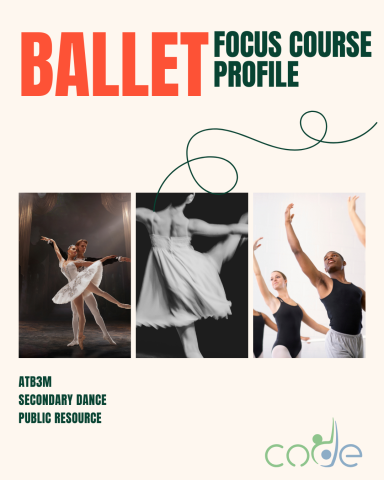
Ballet - Focus Course Profile

Course Profile

This course emphasizes the development of students’ artistry, improvisational and compositional skills, and technical proficiency in global dance genres. Students will apply dance elements, techniques, and tools in a variety of ways, including performance situations; describe and model responsible practices related to the dance environment; and reflect on how the study of dance affects personal and artistic development. This course will focus on Ballet.

Course Overview

This course will allow students to develop their technical abilities in ballet as well as expand their knowledge of aesthetics, culture, health and wellness. They will expand their understanding of ballet by studying one or more ballet techniques (e.g.: Cecchetti syllabus, R.A.D syllabus, etc.).  Students will expand their understanding of ballet terminology and their ability to communicate using this terminology in the creative and critical analysis processes. Students will examine the history of ballet and learn about its development from the 1500's to the present. Students will be challenged to reflect about the purpose and place of Ballet in the contemporary dance world and from a global perspective.

Scope & Sequence

Unit Descriptions

Unit 1: Etiquette, Pedagogy and the Technique of Ballet (40 hours)

Students will develop an understanding and practice of R.A.D. and/or Cecchetti technique to further develop their technical skills.  It is recommended that this unit be delivered over the entire course. Safe dance practices will be observed so that a secure dance environment is available for all students, regardless of level of experience with this dance form.  Students will expand their dance vocabulary and knowledge of ballet terms.  The critical analysis process will be used to examine the components of a healthy dance practice, and to develop the students’ ability to be reflective of their own dance practices and body image.

Unit 2: Ballet: An Historical Perspective (20 hours)

In this unit students will follow the transformation of ballet from the beginning of its existence in the 1500’s to its current status as a significant dance form in contemporary society. Students will explore the cultural roots of ballet and learn about key dancers and choreographers throughout history as well as its traditional link with classical music. Students will learn about Jean-Georges Noverre, a french ballet dancer turned choreographer, who helped codify what is now modern day ballet. They will study ballet's timeline and learn about the different eras of ballet dance and the most significant events (the first ballet, Louis X1V (Sun King), the first performance by a professional female dancer at a theatre, the first full-length ballet on pointe, the Pas de Quatre, The Dying Swan for Anna Pavlova, The Ballet Russes, etc)  Historical understanding will be used to make predictions about the future role of ballet in the dance and performance world.

Unit 3: Ballet in Contemporary Society (20 hours)

Students will observe a variety of professional and non-professional ballet performances, live and on video.  Students may visit local studios to observe classes and to understand the role of ballet in dance training, including university or college reach-ahead experiences. Students will engage in critical thinking about the changing nature of ballet, the definition of a classical dance education, stereotypes within and about ballet, cultural inclusiveness, elitism and exclusivity. Particular attention will be given to the evolving role of ballet in contemporary society. Students will develop an awareness of the dancers, choreographers, companies, and career opportunities that exist within the existing global ballet community. Students will reflect on their learning in a way that is personally meaningful (i.e.: journal writing by hand or on a computer, video reflections, scrapbooking, blogging, etc.) to document their journey and then share at least three pieces with the class.

Unit 4: Narrative and Abstract Ballet (15 hours)

Students will examine narrative ballets (The Nutcracker, Cinderella, Romeo and Juliet, etc)  and abstract ballets (The Four Seasons, Apollo, Serenade, Agon) and compare and contrast them. They will also study the historical roots of the narrative and abstract ballet and which choreographers were pioneers of these two types of ballets. Students will have the opportunity to create narrative and abstract ballets using one of the ballet techniques (Cecchetti or R.A.D.) learned in the course and using their choreography from the narrative and abstract creations, fuse these two styles together by choosing a compositional form that works best (e.g., Rondo A= narrative and B, C and D= abstract OR Binary A=narrative and B=abstract OR Ternary A= narrative B= abstract and A= narrative, etc).  Students will work through the creative and critical process and use peer and teacher feedback to revise and refine their work.  The presentation of the pieces will be used as a summative activity as well as the journal of ideas and notations of the choreography. In addition, students will contrast and compare a narrative-based ballet and an abstract-based ballet of their choice and write a comparison essay about the ballets.

Culminating Activity

Communicating Through the Language of Ballet (25 hours)

Students will be exposed to fusion ballet and explore how ballet is being modified and adapted for performance in our contemporary global dance community. The teacher may wish to show B Squared- a bharatanatyam and ballet piece choreographed by Mavin Khoo. In small groups, students will create a short fusion ballet (ballet and another form of dance) using the creative and critical analysis processes. Students will choose a theme based on social activism, environmental issues, stereotype/discrimination issues or any idea that is inspired by social commentary or current events. Students will develop their pieces and set them to instrumental music. The compositions will be shared within the classroom for feedback and analysis by peers and the teacher. Students will use the feedback to refine and revise their dance pieces. Evaluation of the culminating activity will focus on their creative and critical analysis processes, ballet technique and performance skills. Their knowledge and understanding of various ballet forms and styles will also be assessed as a culminating activity.

Resources

Books

Arnheim, Daniel D. Dance Injuries - Their Prevention and Care. Pennington, NJ: Princeton Book Co. 1991 ISBN 0-87127-146-X
Au, Susan. Ballet and Modern Dance. 2nd Ed. New York, NY: Thames and Hudson, 2002.  ISBN 0-500-20352-0 
Beaumont, Cyril W. Stanislas Idzikowski. The Cecchetti Method of Classical Ballet.  Theory and Technique. Mineola, NY, Dover Publications 2003  ISBN 0-486-43177-0
Franklin, Eric. Dance Imagery for Technique and Performance. USA: Human Kinetics 1996 ISBN 0-87322-943-6
Pakevska, Anna, Both Sides of the Mirror The Science and Art of Ballet. Pennington, NJ: Princeton Book Co. 1992  ISBN 0-87127-180-X
Gaynor Minden, Eliza. The Ballet Companion A Dancer's Guide to the Technique, Traditions, and Joys of Ballet. New York, NY: Simon & Schuster, Inc. 2005 ISBN 978-0-7432-6407-5
Gilman, Phoebe. Something from Nothing. Richmond Hill, ON: Scholastic Canada Inc. 1992,  ISBN 0-590-743802-X
Richardson, Jean. The Bear Who Went to the Ballet. Toronto, ON: Stoodart Publishing Co. Ltd. 1995 ISBN 0-7737-2915-1
Thomasen, Eivind and Rist, Rachel-Anne. Anatomy and Kinesiology for Ballet Teachers. London, Great Britian: H. Charlesworth & Co. Ltd. 1996 ISBN 1-85273-048-X

Internet

Information

http://artsalive.ca/en/dan/dance101/forms.asp

Ballet Clips
Various performance clips: http://artsalive.ca/en/dan/mediatheque/videos/videos.asp 

Cinderella: http://www.youtube.com/watch?v=SOKLn-9izMA - Ballet Jorgen

Romeo and Juliet: http://www.youtube.com/watch?v=rYzZUQQuxgA  - Ballet Jorgen

http://www.balletjorgencanada.ca/index.cfm?pagepath=Home&id=19790 - Ballet Jorgen website

The Four Seasons: http://www.youtube.com/watch?v=Om6E7aTDshY - performed by Atlanta Ballet 

Jewels: http://www.youtube.com/watch?v=-DFIR0v31Y4&feature=related -- performed by Paris Opera City Ballet

Ballet Fusion Clip 
http://www.youtube.com/watch?v=gVya_lIPTBU - 'B Squared' danced by Sampradaya Dance Creations

Sampradaya Dance Creations Website - Information about 'B Squared' http://www.sampradaya.ca/article/articleItem.cfm?cms_article_id=1

Instructional Strategies

Small and Large Group Discussion/Brainstorming

Cooperative Learning

Creative Process

Critical Analysis Model 

Video Viewing and Analysis

Question and Answer

Direct Instruction

Brainstorming

Gallery Walk

Glossary of Terms Specific to Course

Abstract Ballet - This type of ballet focuses on abstract movement and concepts and is non-thematic.

Cecchetti - This method is a form of ballet instruction created by Enrico Cecchetti (1850-1928). It is a strict training system with special concern for anatomy within the confines of classical ballet technique, and seeks to develop the essential characteristics of dance in its students through a rigid training regime. The method traditionally has seven grades with examinations up to diploma level. (Source: Answers.com)

Classical Ballet - A form of theatrical dance that has evolved over the past 300 years from its origins in France. It is highly academic in its training and technically demanding in performance. It differs from other forms of dance in its fundamental requirement for turnout, in which the legs rotate 90 degrees in the hip socket to allow greater freedom of movement, thus giving ballet its distinctive line. The use of pointe work is also common in classical ballet. (Source: Answers.com)

The Four Seasons -  Is an abstract ballet originally choreographed by Jerome Robbins, set to Verdi's classical music and re-choreographed by James Kudelka of The National Ballet of Canada.  

The Nutcracker - Is a narrative ballet that dramatizes a children's story of Christmas. The original ballet production was staged by Marius Petipa in 1892. The music was composed by Peter Ilyich Tchaikovsky. (Source: Answers.com)

Narrative Ballet - follows a storyline (beginning, rising action, climax, falling action and resolution) and may convey specific meaning or concepts through that story. The meaning could be literal or metaphorical. (Source: IRA/NCTE)

Notation - A system of recording dance (e.g., Laban notation) so that others may re-construct a dance work.

Royal Academy of Dance (R.A.D) - The Royal Academy of Dance was established in London in 1920 by a small group of eminent dance professionals. RAD training is known for technical proficiency and clean lines. It emphasizes correct placement and academic lines, which force the dancer to pace his or her dancing and give attention to each step. (Source: The Free Library)

Refer to curriculum document glossary for all other terms.

Examples of Activities

Unit Four - Narrative and Abstract Ballet - Comparing, Contrasting and Composition

BLM #1 Ballet Theory (Unit 1)

BLM #2 Rubric - Fusion of Narrative and Abstract Choreography (Unit 4)

Assessment and Evaluation Strategies

Rubrics 
Peer Evaluation
Self Evaluation
Journal Writing/Designing
Exit Cards
Teacher Observation
Composition Work

Unit 4 Sample Lesson: Comparing, Contrasting and Composition

Critical Learning

Guiding Questions

Ballet is a traditional form of dance that is evolving in today’s society. There are three major forms of ballets; narrative, abstract and fusion. 

What is a narrative ballet?
What is an abstract ballet?
What are the similarities and differences of a narrative ballet and an abstract ballet?
How are the movement vocabularies similar and/or different?

Curriculum Expectations

Learning Goals

Creating, Presenting and Performing

A3. Dance Techniques: demonstrate an understanding of the dance techniques and movement vocabularies of a variety of global dance forms

A3.2 accurately reproduce a range of dynamics and movement techniques from a variety of global dance forms

A3.3 create and perform compositions that blend the vocabulary and technique of two or more global dance forms

Foundations

C2. Contexts and Influences: demonstrate an understanding of the social, cultural, and historical origins and development of dance forms, including their influence on each other and on society;

C2.1 demonstrate an understanding of key developments in Canadian Dance History, including the artistic contributions of Canadian dance pioneers 
Learning Goals
(Unpacked Expectations)

At the end of this lesson, students will be able to:

  • Distinguish the difference between narrative and abstract ballet and list the similarities and differences
  • Choreograph a short narrative and abstract ballet using the elements of dance, characteristics of the type of ballet and the compositional tools and forms
  • Express their understanding of ballet through the use of ballet vocabulary   

Instructional Components

Readiness

Students have been working regularly on their ballet technique
Students have researched the history of ballet and have had a chance to observe ballet performed in a variety of settings. 
Students are familiar with traditional Narrative Ballets
Students will have had experience working independently, and in small and large groups. 

Terminology 

Narrative Ballet
Abstract Ballet
Notation
(see Glossary for these terms)

Materials

Internet Access to show a Narrative and Abstract Ballet
Student journals
Chart Paper and Markers
Lined Paper and Pencils
CD Player
Variety of music selections
BLM #2 Rubric


Approximately 30 minutes

Minds On 

Pause and Ponder

Pairs > Think/Pair/Share

Invite students to choose a partner and give each pair a post-it note.  Ask students to write down on one side what a narrative ballet is and on other side what an abstract ballet is.  Instruct students to join the circle when they are finished. Instruct students to volunteer what they think a narrative ballet is and what an abstract ballet is.  After the discussion, sum up what a narrative and abstract ballet is (using the glossary).   

Whole Class > Viewing a Scene from a Narrative and Abstract Ballet

Have students watch
excerpts from Ballet Jorgen's 'The Nutcracker'(narrative)
and a clip from 'The Four Seasons'
James Kudelka's 'The Four Seasons' (abstract).  
As students are watching each, ask them to use a graphic organizer to organize their thoughts (mind map, fish bone, t-chart, placemat etc).  Tell students to look for the following:
  • movement quality
  • the elements of dance
  • the compositional tools and forms
  • other observations/thoughts/feelings

After watching the clips, invite students to share their responses with the class.  

Small Group > Similarities and Differences - Venn Diagram

Ask students to get into a group of 4 or 5 students and create a Venn diagram.  In the middle write down similarities of a narrative and abstract ballet and on the right side write about the differences of a narrative ballet and on the left side write about the differences of an abstract ballet.  Allow 5-10 minutes for this.  Ask groups to share their Venn diagram with the class. 

Assessment for Learning (AfL)

Post-It Note of knowledge of narrative and abstract will help to inform planning for future lessons
Peer Evaluation of work-in-progress

Differentiation (DI)
You may wish to provide the graphic organizers for students who have a difficult time with organization
Teacher may wish to assign a narrative and abstract ballet to each group and then students can re-work and use the ballets as a starting point (e.g., give students 'The Nutcracker' and 'The Four Seasons' and ask them to use these as inspiration for choreography)
 
Quick Tips
If possible, live performance opportunities may be accessed in lieu of videos.
Provide students with support when looking for ways to express themselves outside their comfort zone.
Link and Layer
Assign students the task of finding as many titles as they can of narrative and abstract ballets.
Hyperlinks in the Lesson
http://video.google.com/videoplay?docid= 5694956143021101991#
http://www.youtube.com/watch?v=zRdD6chE9Mk
Approximately 210 minutes

Action! 

Whole Class > Instructions for Choreography Assignment/ Challenge and Inspire

Explain to students that they will be placed in small groups and that their task will be to create a short narrative ballet (1-2 minutes) and a short abstract ballet (1-2 minutes) using ballet technique, elements of dance and compositional tools and forms.  The choreography will embody the characteristics of each type of ballet and will be clear to the audience when the dancers are dancing a narrative ballet and when they are dancing an abstract one.  Handout BLM #2 Rubric for Assessment of Narrative and Abstract Fusion Dance

Small Groups > Imagine/Innovate and Plan/Incubate

Place students in their small groups and instruct them to use a journal for the planning and creating of their narrative and abstract ballet.  Discuss what notation is and encourage students to devise their own notation system.  The journals can be used as a summative assessment piece.

Small Group > Explore/Experiment with Choreography

Allow students to work on their choreography of a narrative and abstract ballet.  They will work on creating a story and work on creating a dance work that is conceptual.  Using a compositional form (AB, ABA, ABACAD) students will fuse both the narrative and abstract compositions together. (This could take up to 3 or 4 classes subsequent classes)

Larger Small Group > Analysis/Feedback and Revise/Refine

Instruct students to work with another group.  In these larger small groups, students will give feedback - strengths and areas for improvement.  Students will take the feedback and continue to work on their fusion pieces. 

Whole Group > Present/Produce

Invite students to share their dance pieces with the class.  Remind students of proper audience etiquette.  Groups may wish to explain the story and concept as well as the compositional tools and forms used BEFORE the presentation or AFTER.  (Teacher's discretion)

Approximately 30 minutes

Consolidation 

Whole Group > Debrief of Fusion of Narrative and Abstract Dance Pieces

Instruct students to reflect on the presentations and share with the class their thoughts, feelings, initial reactions and ask them to discuss where they saw the elements of dance and compositional tools and forms being implemented.

Individual > Exit Card

Ask students to complete an exit card containing the following information before leaving:

  • title of narrative and abstract ballet (as watched in Minds On)
  • the choreographers for each
  • movement qualities of each
  • the story OR concept behind the piece
  • the story AND concept of THEIR choreography
  • one similarity and one difference of narrative and abstract ballet

Whole Group > Circle Reflection

After students have completed their exit card, invite students to sit in a circle and share one aspect they have learned about narrative or abstract ballets.